
1
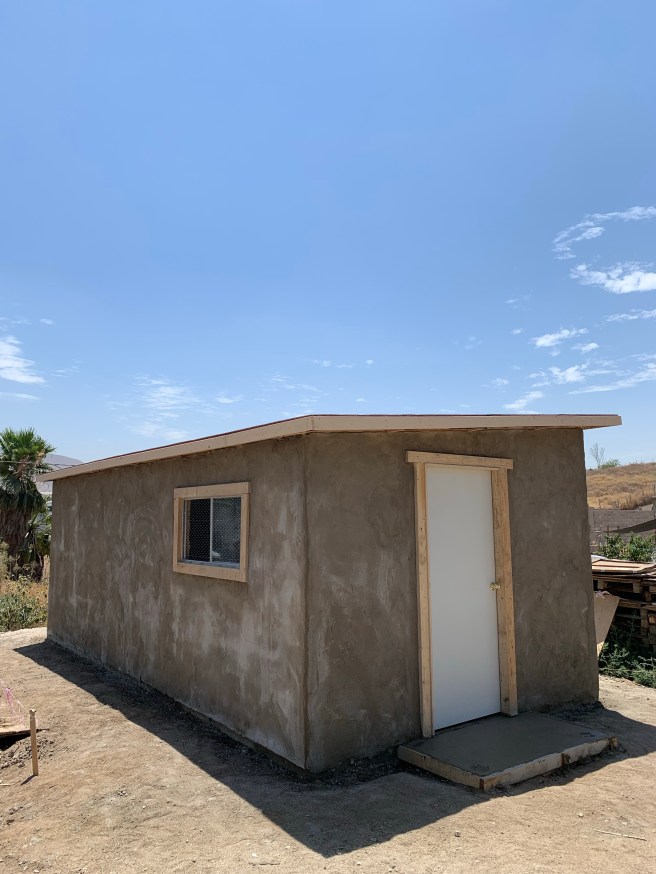
Five-forty, let’s go. A smoky, hazy morning on the outskirts of Tijuana, what’s new. The rooster calls, “Go commando!” We don’t have much left to do on the house today. Another coat of stucco, that’s about it. The family and their friends are going to make us lunch.
I’ll head over to the mess tent to see if the coffee is on.
2
Finished the house today. I focused early on wetting the first coat of stucco—yesterday’s stucco.
I’m sitting here under the shade of the mess tent. It’s sunny, hot, and windy. I’m looking across the campground to where another group is staying. They aren’t back yet. I realize now that they must be eating their meals in town, somewhere. Not here. They were getting back to camp later than us. We thought maybe they were using all that time at the work site. We liked thinking we were better than them.
But they don’t ever appear to eat anything here. I see no food boxes, no containers, no pots, no pans. What are they eating? Are they eating? They must be. Do they stop at a restaurant? At roadside stands? I’m curious, and a little jealous. I like the Baja Cooks food but I wonder what kind of food is served up at the many small food stalls we see along the way.
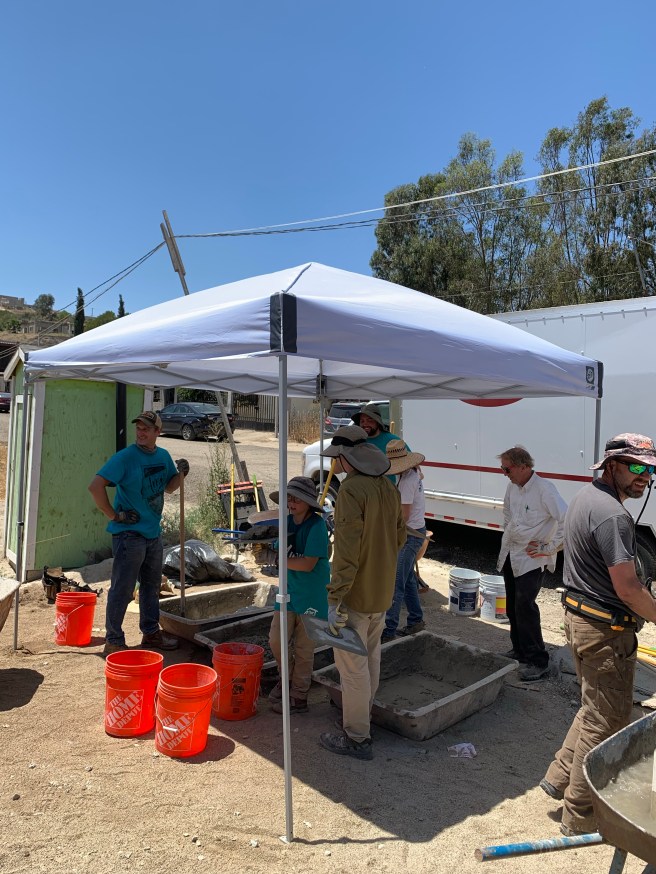
From left, Tim, Cooper, Greg, Dan, Christopher, Tom, and Jason.
3
For the first time now in four trips here, I have finally made my way to the Amor store. I bought a poncho and a bottle of vanilla. Brook’s gonna flip when she sees the poncho. I told her about the vanilla. There were some other campers in the store. A few folks from one of the other groups were buying and quickly drinking bottle after bottle of Mexican Coca Cola. When they finished one off, they’d chuck the glass bottle into a bin. Clank!
I could’ve bought this poncho, or one very similar to it, from the señora selling them from out of the back of her old Ford Explorer today or any day this week at the worksite. The vendors seem to know where the Amor worksites are at and they magically appear to peddle their wares. But they usually visit only right away when we get there and then they leave pretty soon after that. I didn’t want to be rushed trying on ponchos at the worksite while the rest of the group was preparing for the work day: getting our gear out of the van, applying sunscreen, making sure the car is locked, circling up for the morning devotional, and figuring out who’s doing what on site. If I tried a few on and they didn’t fit, I would’ve bought one from her anyway, out of guilt.
Today, that first coat of stucco needed water on it ASAP, and lots. For a couple years now, I have been the main proponent of wetting down the first coat of stucco before the second coat goes on. The second coat will stick better if the first coat is wet. And the first coat should hold up better in the long run if it’s wetted down before the second layer goes on. Even the second coat will be stronger, because it won’t dry out as fast with a little extra moisture underneath it when it goes on. Cement is a wet cure.
I used a sponge to get water onto the first coat, all the way around the house. Then did it again. Una vez, dos veces. When we needed mixers, I put down the sponge and the water bucket and grabbed a hoe. When parts of the second coat were done except for the spots higher up along the walls and by the doors, I got a trowel and a stucco hawk and filled in the gaps. At times, what we needed more than anything were additional people to ferry the mixed stucco from the mixing troughs to the trowelers along the sides of the house.
The mixing is the hardest work. Gustavo and Ivan were helping us mix. They didn’t adopt the Amor method right away but the technique we use is simple, easy, and effective so I urged them to try it out. Like I told Gustavo, “You gotta get that yin and yang going.” You have one person on either side of a mixing trough, each with a hoe. You reach to the far side of the trough and pull the mixture toward you, over and over. Then you switch from pulling the left side of the trough to pulling the right side of the trough. You don’t push the stucco nearly as much as you pull it. A few of the hoes have quarter-sized holes in their face, which makes it easier to pull them through the stucco. It’s like they were made for this work.
In a matter of moments, Gustavo and Ivan had the mixing yin-and-yang going and we had fresh, wet stucco for days. Gustavo did a lot of work with us this week. I left him a bag of tools, which I’m not sure he really even needed. I want to think I’m showing up and offering this bounty but he told me clearly that he already had a set of tools for himself. But that if I wanted to leave my surplus behind with him, he would accept them. They might eventually be given to his very young son. Either way, I was done with them, and they weren’t coming back.
4
Crikey it’s hot. It’s hot now, it’s been hot all week. If it’s going to be this hot here, I only need to bring one long-sleeved shirt. Collared. For sun-blocking purposes. I brought a long-sleeved t-shirt on this trip, but I haven’t worn it.
I only needed one pair of work pants. I’ve worn the Dickies painter pants every day on the site and they were fine. They got the job done but the fabric is a little rough. I’m guessing the Carhart painter’s pants are probably a little nicer, softer on the knees.
My throat is sore but I don’t think I’m sick. It’s the cement dust. Now, an allergy attack. I’ve only used the nasal spray this week. No pills. Something just snuck up on me. Might need to take a pill. I’m blowing my nose; stuffed up.
More packing notes. I brought an extra trio of AAA batteries, but I’m not going to need them. I figured they would come in handy, for me or for someone else. Not the case. What our crew does need are more phone chargers. Specifically, we need more of the mobile battery packs. I have two, brought just one. Could’ve used both.
On this trip, I have acquired two Amor shirts. One was a gift from Mike Mayer. He bought everyone one. It used to be that Amor would make a new shirt every year; everyone who came here to camp and to work on a house got a shirt. But the freebie shirt days are over, perhaps a victim of the pandemic. So Mike went to the Amor store and bought up a bunch of shirts from prior years, which they sell at the store. The other Amor shirt I acquired came via my Secret Pal, Doug.
When I gave Gustavo my leftover tools, I also gave him the tool bag I brought on this trip, an old Washington U over-the-shoulder bag that my wife acquired at work. We kept it for a while, and it was a good tool bag for this trip but now it’s going to spend some time in Tijuana. Among the tools I left with Gustavo was a cat’s paw, useful for pulling nails out of wood. I’ll buy another. I am taking a speed square home but it’s not the one I came here with. I swapped the metal one I brought for a plastic one I found in the big Amor toolbox of misfit tools.
I haven’t gotten rid of much of anything else I brought. I have shed the items I brought for my Secret Pal: a Moleskine, three pens, a can of Pringles, and a bag of Life Savers. I did get rid of that heavy water. Just now, the last of it gone.
Looking outside the tent in this evening light not yet tempered by the fall of the sun, I see what appears to be a wasp tugging on the zombified carcass of the black widow spider!
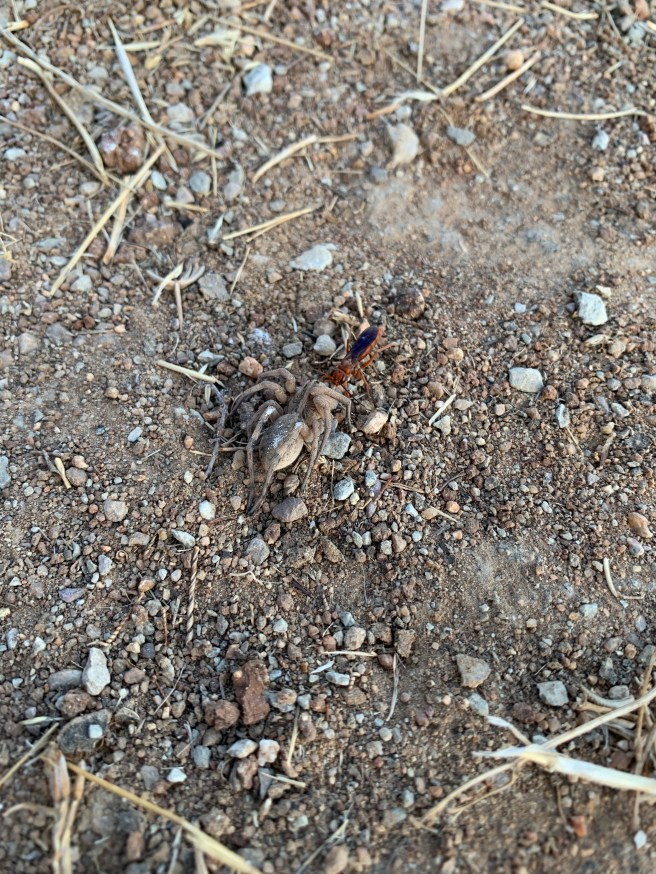
Many wasps prey on spiders, which I find fascinating. That little red wasp pulling with all its might a much larger, paralyzed spider back to what I assume is a nest on the other side of a little hole in the ground. There’s no way I can be certain that the gray spider was the widow but it looks like the right size, the right shape. It’s just not the color the black widow was, when it was.
The clank, shudder, clank of the gas truck operation. North Star Gas. The tankers come and go—pulling some kind of gas from a pipeline terminal. Probably propane. There is no train service back in there. The clanking metal on metal sound is almost like the sound you used to make when you dropped a quarter into a payphone or into a jukebox. Those were simpler times.
5
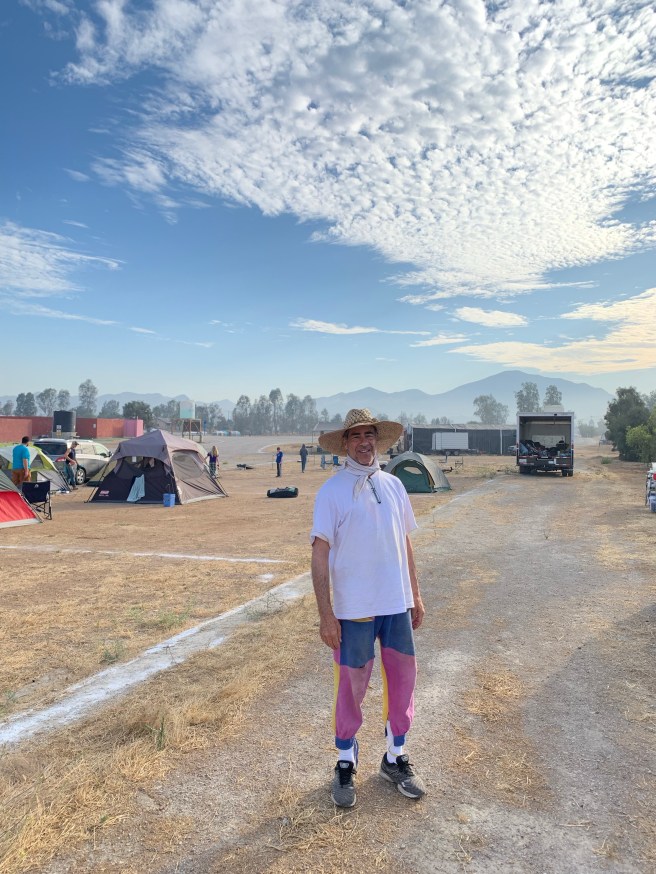
Peter burned his pants. On the first morning of work, he clambered out of his tent and walked toward the mess tent where several of us were having breakfast. There were a few snickers, several smiles. Not one to avoid the obvious, Peter said, “Let me guess, you’re laughing at my pants.”
Years ago, Peter took a trip around the world. He has a book of poems and these pants as mementos. The pants, specifically, came from Nepal. They are a sort of quilted pant; pieces of several colors of fabric sewn together. This trip was going to be their last hurrah.
Many of us grew to like these pants. So when we watched him put them into a trash can in the mess tent earlier this evening, we objected. Jim spoke up immediately, voicing what I was too shy to say.
“Were those your pants you just put into the trash?” Jim asked Peter.
Peter was reluctant to pull them back out of the trash but we clamored. We laid on the guilt. He couldn’t just throw them away, how unceremonious. A trash can was not a fitting final place for pants as colorful as these.
We suggested a tribute. Someone said, “Why don’t we burn them in tonight’s fire?” Everyone seemed to think this was a fair and just conclusion. Peter had had these pants for 33 years.
Before the Large Group convened, he laid them on the ground near the fire. We sang a few songs. It was starting to get dark, not yet gloaming. Dan wanted to start the group discussion and get us moving toward our final Small Group meetings of the week.
That’s when Cooper began to chant, “Burn the pants! Burn the pants!”
His chant was seconded by a low chorus for a few repetitions before Dan moved to quash the idea. But Cooper wasn’t willing to stop his plea. Finally Dan said, “Alright. Let’s burn these pants. But then we’re going to do the Reading and break into Small Groups.”
Which elicited a round of cheers, prompting Peter to get up from his chair and take the folded pants into his open palms. Saying nothing, he held out the pants for everyone to see, then he knelt and placed them on the fire. At which time, Ella, Logan, Griffin, Chris, and Cooper stood up with their hands held to their heads in a fitting salute.
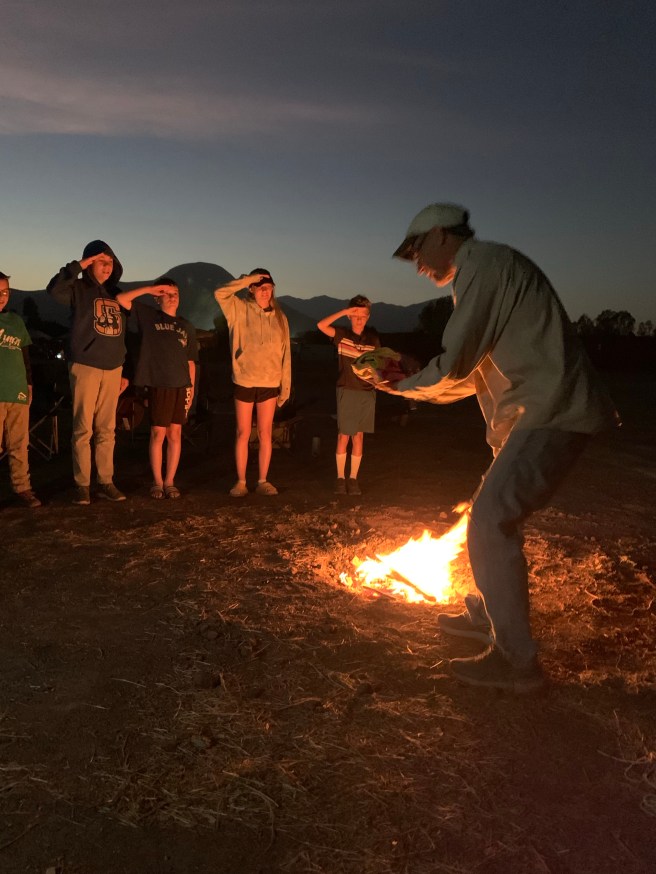
As the fire began to take the pants, the kids began to sing “The Star Spangled Banner.” Which at first made me and the others chuckle. It was a funny, odd selection of a tribute song but it somehow felt right. They knew the Banner and they were not going to sing just a few lines.
Before I knew it, I was joining in. Frank stood up and walked toward the fire to join the kids in their singing. I was not the only one who substituted “Peter’s pants” for “the flag” in the line when it was “still there.”
What Peter laid on that fire was an emblem, our flag of the week. The only way to say goodbye to something that means more than what it was is to set it on a flame and watch it go until it’s gone.
6
I don’t have a pillow now because I’m wearing it. Particles of smoke float in the light of my headlamp. No view of the mountain in the north because of smoke.
My throat remains sore. I’m a little worried but I’m still confident it’s due solely to cement. I cut one bag open, mixed a lot of dry cement for stucco from others. We did good work today up and down the line informing one another when the stucco we were sending out was too dry. Never did anyone report it being too wet. Add the water bit by bit. You can always add more. Stucco, like mortar, goes from dry to soupy in a quick moment, only a little bit of too much water pushes it over the line.
Having the shade canopy set above our stucco mixing station was a huge help. Mixing concrete in full sun for the pad on Monday was hot and stressful. What a difference a shade makes.
In my mind as I fight sleep on my last night here on the outskirts of Tijuana, I am going back over all of the week’s work. How did we level that dirt pad on the first day? What was the trick? Did we level the forms? What was that string we set up? How did we know that string was level? I was there, and I was a part of it, but already I have forgotten.
Oh, yeah, that’s right. We screeded the dirt along the forms with a 2 x 4 attached underneath the screed board. We raked and picked and shoveled our way to level. Forms level, board screed, pick, rake, and remove. But I’m missing something. And if I come back next year, I will need to know it. I will ask someone tomorrow. They will know.
I gotta go to sleep. 23:57. Damn—
7
5:22, Friday morning. Slept in my new poncho!
El fin.

8 Postscript
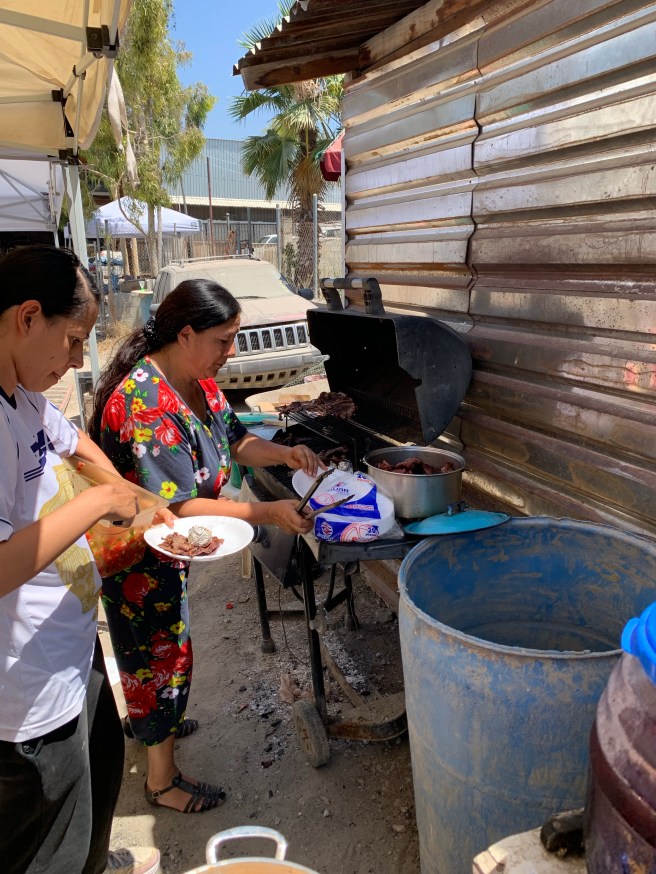
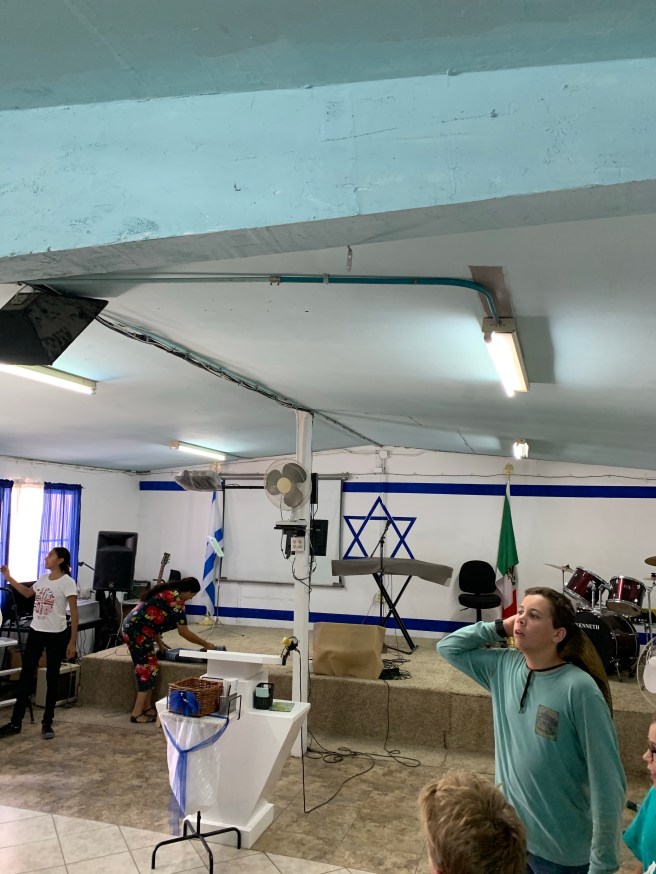
There are, as there will always be, parts I never wrote about and it’s too late now. But I have a few photos I still want to share from the last day in Tijuana. I want to share a couple photos from the lunch the family and their friends made for us, carne asada. And then there’s a photo from inside the church run by the preacher who was so nice to us at the work site. We went into the church after lunch. It was air-conditioned. The preacher is very proud of his church and would have talked for many hours about his faith. At one point he was talking about the Shroud of Turin. It was interesting. I know at least one reader who will appreciate seeing that photo. Thanks for reading!

Discover more from JBR.com
Subscribe to get the latest posts sent to your email.
 JBR.com