
We’re in a La Quinta Inn near a place called the Wichita Sports Forum, a sports complex, the parking lot of which is full, patrons coming and going, collapsable chairs in hand. The clientele here at the hotel seems to be made up largely of Sports Forum patrons.
My wife went out to pick up pizza. I’ve done several trips to and from the car. Otherwise, we’re going to hunker down in our room. B said she walked into the lobby wearing her mask and attracted all sorts of weird looks; no one else had a mask on. The clerk behind the desk wasn’t wearing one. We had a reservation. He said the place is totally booked.
I watched the Belmont Stakes. There’s a golf tourney on from Hilton Head, in which I have a very mild interest. I’ve also had the news channels on, curious to see footage from Tulsa, where the President is holding a rally, set to begin in less than two hours.
What we see here leaves us with the impression that perhaps this state, this city, was never under any level of coronavirus restriction. I’d wager there are a couple hundred people in that Sports Forum. Climbing, basketball, gymnastics, volleyball, maybe some soccer. The Dave and Buster’s is open. The pizzeria was doing good business. It’s all sorts of people coming and going from this hotel. Young and old. Black and white.
It’s June 2020. In a place the virus has yet to touch, my wife and I reach the same instinctive conclusion: it’s only a matter of time. It would not be a surprise to hear that Wichita, KS, was the next new hotspot for a virus very alive, very capable, and, like us, on the move.
Ideally, the cooler is never more than half full. Heading out, we packed it to the brim, trying to avoid leaving food behind in a fridge we wouldn’t open again for two weeks. The ice we put in was in the form of various plastic bottles full of frozen water. Two long-emptied Ten High bottles have stuck around for months, proving their worth in this way, as handy, sturdy, reusable containers of frozen water.
We only started adding cubes of ice in Wichita, from the hotel ice machine. But before that, in the hotel parking lot, as I searched the cooler for the items I wanted to take into the hotel, I began to become annoyed by all the cooler contents I wasn’t soon going to use. Did we need a half-gallon of orange juice? A half-gallon of milk? The bar of chocolate didn’t take up much space but its paper wrapping was starting to disintegrate. Hugo’s cans of wet dog food and pumpkin puree could not have been left behind at home—I’d just opened them. But I had those so-called ‘can savers’ on top of each can, baby blue silicone lids that stay on well enough in a fridge but were now on the verge of being dislodged in the rough and tumble of a fevered cooler search, a hunt for that one specific can of cold beer at the inevitable bottom.
We had two blocks of cheese in the cooler; a jar of strawberry preserves; a package of smoked trout; and, a big salad in a bulky plastic container. We’d use it all eventually but until we did, these items were all just obstacles.
There wasn’t much we could do about it, other than make detailed plans about how we were going to go through it all. In Tucumcari, we agreed, we’d eat the salad. Then we could get that container out of the way. We could consolidate some of the loose items in a large ziploc bag. We’d start in on the OJ; we’d mix the two cans for Hugo into a common, sturdy container, such as the one we’d emptied that afternoon of Straub’s Markets pricey but delicious chicken salad.
Except when the time for dinner arrived I didn’t have any interest in the salad. I wouldn’t eat any of that until the morning. Life had intervened, this time for the better.
As intent as I had been to eat the food we’d brought—we agreed we did not have to go to McDonald’s—a better offer had come along, and I didn’t even have to ask. Incredibly, I’d have myself a taco for dinner, filled with freshly grilled steak and topped with a smoking hot tomatillo and chile salsa. All because I was able to keep calm; to keep from overreacting when a makeshift cantina appeared outside our ground floor room at the Best Western Discovery Inn, where we had a little two-seater patio, separated from the parking lot by a thin metal railing. And where, now, several drinks in, we are happy to have a little space to ourselves outside our pet friendly, corner room.
Hugo and I have stayed in this room before. It might be one of only a few pet friendly rooms in the whole motel. The prior stay was uneventful. Quiet. Peaceful. Under the wide New Mexico sky, generally accented with a number of big, puffy clouds, sits the eponymous Mt. Tucumcari, like an aircraft carrier made from adobe, hulking right there beyond the sliding glass door. But when we got into the room this time, I knew immediately we had a problem brewing.
I parted the back curtains to see a contingent of road construction workers pulling their pickups into a practiced formation across the width of the back parking lot. From the backs of the trucks came a parade of gear, some of which they were beginning to set up right outside the railing of our room’s little patio. From the back of one truck a man pulled out a couple of tables, popped the legs, set those down. Another guy hauled out a propane tank, another guy a grill. I said to my wife, “I cannot believe this is happening.”
I could feel my pulse quickening. We had two options. Either we hunker down, close the curtains, put earplugs in, and give up any notion of sitting outside to watch the sunset over Mt. Tucumcari. Or we engage this crew, in some way—introduce our presence, give them just a hint that they were setting up right on the back doorstep of our occupied room.
Once I removed a wooden door jamb, I was able to open the sliding door and step out. Outside the back of our room, I was quickly within six feet of several of these men. Oh, hello. They began to create some distance. Although their road-work trucks and their pickup trucks were strewn all throughout the motel’s sprawling parking lot, there were no vehicles parked right next to the patio. They had other parking lot space to slide their tables and cooking gear into, away from our particular stoop, and they did just that.
I started by saying hello, asking one guy about the nature of their work. What were they working on? Were they from around here? Did they stay at this motel a lot? Small talk, a category of conversation I often refuse to practice.
But the small talk served a purpose. It allowed me to show these guys I wasn’t going to start complaining immediately. I wasn’t asking them for anything, not explicitly. It’s true I didn’t want them right on the other side of our meager railing. I was worried about what looked to me like the makings of a raucous party. Two dozen road crew workers, some music, perhaps alcohol was on its way. How long into the night might they go on?
The guy I chatted up was wearing a backpack, gym shorts, and flip flops. He was white; we spoke English. He was from Tucson, the very destination of our trip. He told me the crew puts down road pavement. Asphalt, then sealant. They had all sorts of specialized trucks and equipment on trailers parked not just up and down the motel parking lot but overflowing onto a dirt and gravel lot reaching beyond the motel proper. Over the road truckers use the same lot to park their semi-trailers.
Most of the crew, especially the men setting up the makeshift cantina, were speaking Spanish. I was suddenly comfortable with how the evening was unfolding. I sat in one of the chairs on the patio and took in the scene, trying to pick up some of the language as they prepared their dinner.
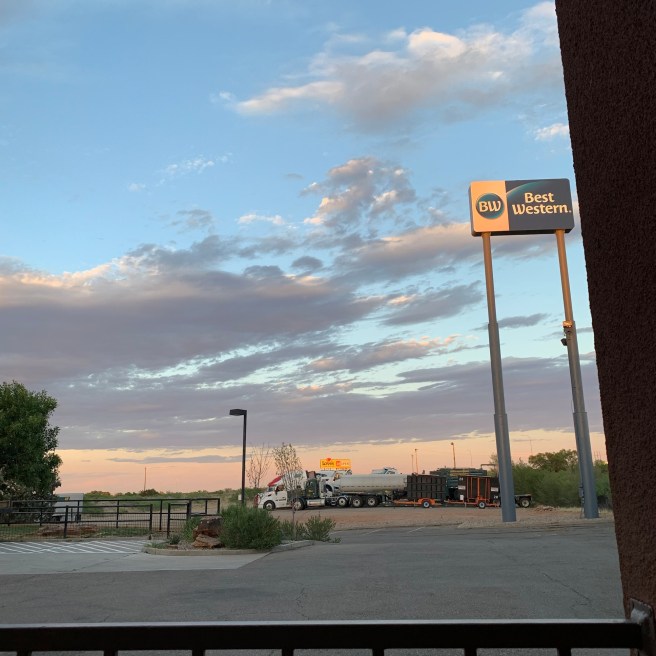
B joined me out on the patio, as did Hugo. There was plenty of late light, dry and to the point. It was June 21, the solstice, in Tucumcari, New Mexico. The mountain stood still as an array of communication towers on it blinked their red lights, off and on.
The road crew was playing Spanish-language music with lots of accordion in it, bouncing. More and more road workers found their way around the corner to the pop-up mess hall in the back parking lot, some acknowledging us as they walked by, saying hello. I sipped beer and sparkling water. B had some wine, ate some salad. Hugo laid down on the concrete patio and watched the people mingle.
I was picking out some words I knew. I heard primo several times. Cousin. Soon it was clear the Spanish-speakers were bilingual. About a third of the crew was white. There might have been a little bit of separation along this line, but these guys all seemed to get along. Somehow they had gotten power to a blender. It was chock-full of dried red chiles and tomatillos. Food was on the grill. Steak, chorizo, and chicken.
Then the head chef looked in my direction and asked me, “Are you ready?” And I wanted to reply, “Sí, estoy listo.” But I just looked dumbly back at him, not saying anything. Was he really talking to me? Was there someone leaning against the corner of the building behind me? No. He asked me again, and I gave some gesture in the affirmative.
“I’ve got food for you,” he said, “One taco, OK?”

I couldn’t believe my luck. It was several minutes before I got the plate of food but I was content sitting there, at the fringe of what felt like a celebration. We learned through occasional questions that they didn’t cook food this way every night; only when the bossman called for it. An 18-pack of Negro Modelo arrived. But the Latino men appeared to be pulling only red cans of Coca-Cola from a cooler in the back of one of the pickups. They were eating tacos, giving compliments, joshing each other. The mood was jovial, not rowdy; warm.
Until a young woman appeared on the scene. Or was she just a girl? When she showed up, one of the white fellas on the road crew started to get animated. I had seen her walk out earlier, in slippers, to that vast, gravel overflow parking lot, where the semis were parked. She wasn’t associated with the road crew, but with one of those other trucks. She had on a tie-dyed t-shirt and those white, fuzzy slippers. From the semi, she waltzed right into the midst of the cantina, making us think for a minute she was the wife or the girlfriend of one of the guys on the road crew. Then I heard her say, “Oh, so you do know the word for cash.”
She came and went at least a couple of times. I’m pretty sure she got some food. She dispensed some of the water they had on hand in large, blue tuns. Where the spigot was attached, she washed her hands. One of the road crew workers kept saying something like, “Man, that shit ain’t right. She’s too young.” Something like that. I don’t know what he knew or didn’t know. But after I got my plate of food I decided my time on the patio that night was over.
We set out on the last leg of our journey in the morning.
New Mexico. Wide open with mountains always somewhere in the distance. The land scrubby, with vast ranches, and cattle dotting the landscape, a sudden congregation of trees. A small town, or the relic of one. Encino. A rusted sign for a long-defunct motel. B picks the speed back up and the town is once again just a place in someone’s rearview mirror. We turn off onto NM 60, west to Mountainair.
Today marks a worldwide high for single-day Covid-19 case counts. Same for many U.S. states including Missouri, from whence we came. Oklahoma and Texas, through which we passed. And Arizona, to which we are headed.
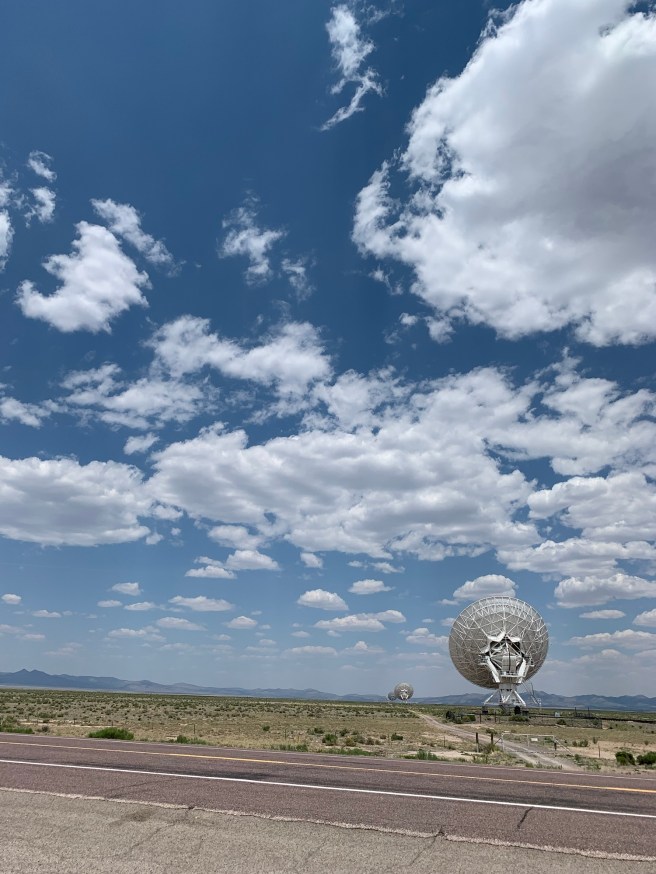
Windmills, cell towers, radio arrays, and power lines. Satellite radio news. No one else out here now but us, and we continue.
Discover more from JBR.com
Subscribe to get the latest posts sent to your email.
 JBR.com