Notes from The Shrine 2: Like It or Lump It

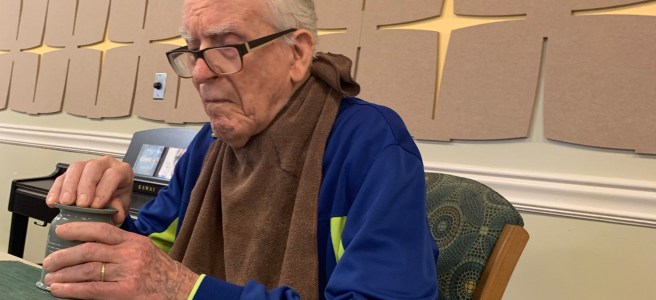
Bob was talking today.  We were at the lunch table and I was telling my dad about getting a dentist appointment set up for him.

“What’d you say about a weapon?” asked Bob.  

I wasn’t sure what he might have heard so I said my dad and I were talking about teeth.  Then I was telling dad about taking mom back to the dealer so she could pick up her car once it had been serviced.  New brakes.  I guess it really doesn’t take that long.

Bob mused on driving, which he said he hadn’t been doing “for about a year now.”  I asked him what kind of car he had.  Or maybe, I wondered aloud, did he have a truck.  He laughed at that idea.

“No,” he said, he never had a truck.  “But who knows once the kids get their foot in there.”

“You never had a truck as part of your job?” I asked.  “Getting up on those poles?”

“That job,” he answered, “was a real pain in the ass.”

Bob was a lineman.  He worked for what then was called Union Electric.  He has spoken fondly about his job in prior conversations so I took this expression of displeasure as a reference to one specific job, some beef or failure or disappointment he must have had out in the field one week...


Click here for the full journal entry...

Notes from The Shrine 1 

Early May 2024

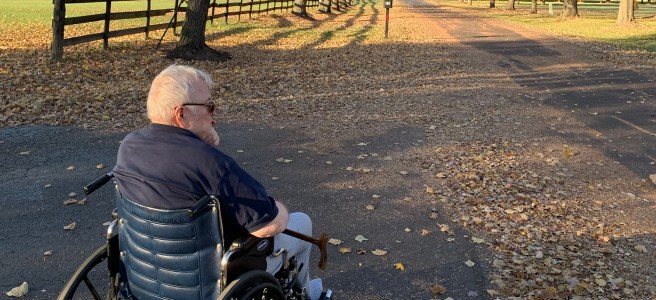
My dad slowly wheeling himself away, his feet pulling, scraping along.

“Yeah, he walked him,” says a woman with glasses, another resident.  “We were down in our house.”

Mass is on the TV, in the common room of this nursing home.  Lunchmate Bob is singing along with the hymn, just the notes.

“Soft smell, the all cough coughs,” says the woman with glasses.  I do not remember her ever saying anything before.  But I do recognize her, she must eat in the assisted dining room.

“They were asking for the Christmas Day,” she says.  “I never heard that one before. Least they’ll give it to the other Christmas.  Have fun.  We had a little.”

She trails off.  I can’t follow the meaning of her words but hers is a musical nonsense language.  Lyrical and sporadic, like a strange bird.

“I throw ye in the class now!”

“Hmm?” asks Bob in reply, thinking maybe she is talking to him.

Lillian, another resident, rocks back and forth in her wheelchair.  She’s spoken to me a few times, thinks maybe I am one of hers.  A lunch will be served in the main Dammert dining room, Dammert being the name of this place, this wing of the retirement community, the last stop on the route, the end of the line.

Bob has gotten an early start on his lunch.  Someone has gotten him a bag of cookies.  Maybe his wife, who lives over in the apartments, independent.  

“I call on the on-derin,” says the woman with glasses.  

“Yeah, hmmm,” says Bob, “Mm-hmm.”

She holds her hands tight, clenched and clawed, thumb to index finger, pill-rolling.

“Hmm?” says Bob, “I can’t hear you.”

The Mayor’s mom is also a resident here.  Helen.  She fell recently, landed on her head.  She looks pretty beat up, a gash on her forehead, dark red, purple, dried blood.

“Thank you,” says Bob.  

Later, at lunch, he turns to me and holds up just the top half of a hamburger bun.  

“This is nothin but bread,” he says, and I can’t disagree.


For most of this year, I have been visiting my dad at a nursing home near Belleville, IL. Dammert, the place he's in, is the skilled care wing of a retirement community at Our Lady of the Snows Shrine. I have kept a journal during many of these visits. It is time for me to begin to type up these Shrine journals. They will not be posted in chronological order. I didn't take many photos early on so some of the photos might be redundant.


Memorial

Somewhere in the 
    lamp-lit dark of
this hospital parking lot
    aye, yes, the hospital I was
born at, a killdeer
    beseeches the night.
It’s got a nest to protect
    a shallow scrape, it’ll
break a wing if it must.

Ambulances come & go.
    For a moment, leaf smoke wafts
while LEDs burn bright
    and it’s quiet, even peaceful.
The beer helps, engines idle.
    A wind sock lit in orange
dangles lazily on the
    hospital roof in a 
mild November breeze.

The night shift leaving in threes
    makes me nostalgic for exit.
Leaves litter the grass below a
    healthy-looking ash.  
The ash gleams leafless
    in this blue-white 
hospital parking lot light.

The first time I was here I
    arrived safe in my mother’s belly.  
Dad had just finished mowing the grass.
    Now I remember.  Even when I can see forward
that forward is never enough.

I awake at two-something in a 
    start.  Is that Mom, coming out?
A tall woman in boots, headed this way,
    unmistakable, alone.  Dad
on a bed somewhere inside.  I rifle through
    my pockets in search of keys;
she is only getting closer.  I find 
    them under me, hit the button,
clamber out of the back seat to greet her and

take her away along empty streets
    to the place we all called home.

Lucky You a Pen

In 1986 my dad’s favorite baseball team, the Boston Red Sox, lost the World Series in heartbreaking fashion to the New York Mets.  The Red Sox had twice led the Mets late in Game Six, repeatedly coming within one strike of winning the game and thereby the Series.  But bad relief pitching and an infamous miscue by the Boston first baseman allowed New York to prevail in extra innings.  

I was seven years old so I don’t remember the game well, but I do remember my dad moving from one room of the house to another, depending on how the game was going, believing superstitiously that how and where he watched the game could affect the outcome. 

The next spring my mom bought me some clothes from an erstwhile store called Venture.  Or it could have been Glik’s.  What I remember is that among those clothes was an orange t-shirt that I really liked.  The Mets wore uniforms with orange trim and their logo is orange on blue.  The t-shirt disappeared.  I asked my mom what happened to it.  Apparently my dad had banned the t-shirt on the basis of orange being a “gang color” but I suspect that the shirt reminded him of the Mets.  

~

You can’t make your bed while you’re on it.  That’s what my mom would say to me as I tried to straighten the covers atop my bunk bed, the higher of two bunks in the bedroom I shared with my younger brother.   At the end of the bunk was a window that looked out over our driveway, toward the house next door where Domino the German Shepherd lived, along with the couple who owned the house.  I could lie prone on the end of my bunk and look out the window, high above our driveway.  

Even though my bedroom was on the first floor it felt like a second-floor view because our driveway sloped down as it ran from the street to the back of our house.  On our side of the driveway was a lovely terraced rock garden that my mom looked after.  On the other side of the driveway was a steeply slanted hedge of unruly ivy and honeysuckle that my dad sometimes clipped.  The valley-like feel of the driveway put our yard at a remove from our neighbors’ yard even though they weren’t but twenty feet apart...  


To read the rest of this essay, click here...

Sketches of East of Here

I. Setting Out.

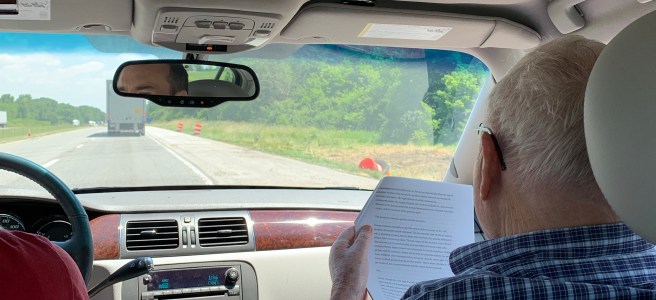
My brother is driving. I'm in the backseat at liberty to write. Dad, riding shotgun, shuffles through sheets of paper explaining stock valuations and physical therapy exercises.

The car is a 2015 Buick Lucerne with 62,000 miles on it and counting. Destination: Ludlow, Massachusetts, where my dad grew up, where he's from, where he still has family: his cousins, his aunt (who turns 88 in two days), his sister (who he hasn't seen in 25 years), his niece (likewise).

We left Belleville, Illinois, at 8 a.m. this morning, yours truly behind the wheel. Football (a.k.a. soccer) streams on satellite radio, channel 157, the European Championship tournament. This is the first round of the tournament, dubbed group play. Earlier, Russia knocked off Finland. Now, it's Turkey and Wales.

It's been awhile since I've been in a car's backseat. I'm enjoying it; it feels like a luxury. Like I'm flying on an airplane. What else is there to do but to read, to write? To describe, to explain, to tell?

At the first rest stop, my dad pointed at some new socks he was wearing.

"What do you think of these?" he asked...


Click to continue with my account of traveling by car to Ludlow, MA with my dad and brother to visit family there...

Oiled Newspaper Hack for Charcoal Grilling

Today I want to write about a “hack” I have been using to get charcoal fires started.  By hack I mean a tip, a trick, a shortcut — in the fashion of a home remedy. 

Over a decade ago, I invited my friend Ray over for dinner and he noticed I was having trouble getting my charcoal grill going.  The method I had been using was to put scrunched up newspaper in the bottom of the kettle, topping that with the smaller of two round metal grills that fit in kettle.  I would dump charcoal on the smaller grill, then eventually place the larger metal grill on top of that.  It’s the larger grill that holds whatever you might be cooking: hamburgers, chicken, bratwursts, whole onions, whole peppers, foil packs of sliced potatoes and butter. Pork steaks, carrots, asparagus, shrooms.

The problem with what I’ll call the “straight newspaper” method is that the newspaper would often burn up too quickly, not having burned long enough to have caught the charcoal, the flame wasting away too soon.  In this event I would have to awkwardly lift the bottom grate, which was a little hot and which was still holding the unburnt charcoal. Then, in a vexed state, I'd have to shove more wads of newspaper down into the bottom of the kettle.  Sometimes I went through three rounds of newspaper before the charcoal would finally catch...


Get your charcoal fire started easily with this one simple trick...

Coal Clams Are the New Storm Here

As we sat down at Mrs. Wilkes Dining Room on our last full day in Savannah, the arrangement of food on the table drew attention.  The number of items itself was only part of the story: sweet potatoes, cheesy potatoes, fried chicken, cornbread, corn, rutabaga, cole slaw, cukes, black-eyed peas, lima beans, stuffing, barbecued pork, cabbage, green beans, jambalaya, white rice, baked beans.  All in porcelain bowls with serving spoons.  This was a family-style meal.  The way it works is that you stand in line outside the restaurant for a half an hour or so.  When one of the tables inside opens up, seven to nine of the people standing in line take a spot at the open table.  When you sit down, the food is hot and ready to go.  You grab a bowl next to you and start loading your plate.  If there’s something you want in a bowl across the table, you ask for it to be passed.  

Anne-Marie didn’t initially sit down.  She set her purse on her chair and went to wash her hands.  Brook had her hand sanitizer out.  I had mine out.  The woman seated to my right asked to use one of the bottles.  She and her husband had driven up from Miami, though they hail originally from Spain.  They had planned to be in Japan this week but canceled that trip because of the outbreak.  The other couple at our table was from Michigan, bringing the total at the table to eight.

I was conscious of the way I handled the bowls when passing or receiving them.  But I also felt resignation.  What’s done is done.  Let’s just enjoy lunch, I thought.  Reflecting back on the meal I’m wondering about the family-style concept in the age of corona.  That restaurant is an institution.  The original Mrs. Wilkes’s grand-daughter came to our table in greeting.  Yet, with the way the news is trending overseas, the word ‘inevitable’ comes to mind.  How do we stop going out to eat?  How many traditions are we willing to concede?  How many will we lose one way or another?  I mean, I’m putting pen to paper on this trip not just because I’m a writer but with a mind to meeting an assignment for a travel writing class I’m taking at Washington University in St. Louis.  My readers are my classmates.  But I don’t know, as I sit here in Savannah, ready to go home, if my class will even convene later this month.  Stanford has already gone online...


What follows is an essay I wrote one year ago as the coronavirus pandemic was taking hold. After multiple unsuccessful attempts to publish it elsewhere, I am happy to publish it here on my blog today. Click here for the full essay and thanks for reading...

A Bad Day for the Phone

“Ack, I just checked my email ten minutes ago. There’s nothing in here for me.”

The phone vibrated, then snapped off, its screen going dark.

“Oh, Phone, don’t be like that.”

“Maybe Bluetooth suddenly doesn’t work tomorrow.”

“Wh—at? Why?”

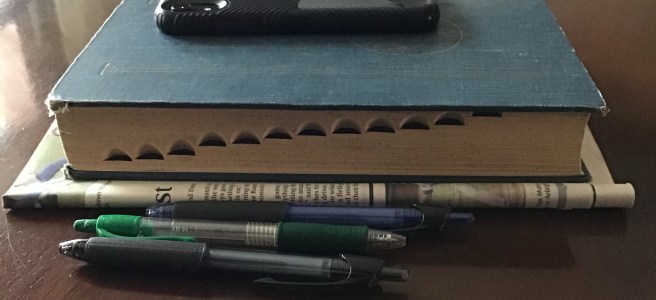
“I saw you reading that old, wrinkled newspaper. I heard you reading it, how could I not have? And then you got that awful dictionary out. How fat is that thing? Just disgusting. I could detect the mold on its pages a room away.”

“OK, I can explain. The newspaper, it wasn’t even mine. The mailman mis-delivered it last week but then—”

“Uh huh. Mis-delivered it?! I’ve heard it all.”

“We’re talking about the post office here….”

“And the dictionary?”

“It’s a family heirloom. My dad gave it to me. It was his at college. It still works. It’s not like I was using another phone.”

“I have a dictionary in here. In here! You see this screen? Flawless. Not a scratch, not a crack, not a blemish on it. My dictionary has any word you could ask for. What’s wrong with that?”

“Nothing, nothing. It’s just nice to turn pages sometimes. I’ll find words I wasn’t even looking for. It feels more real.”

“More real?! I’m not real? That’s it!”

“Phone, where are you going? Phone, get back here. Phone, no! Do not go anywhere near that toilet!”