Sketches of East of Here

I. Setting Out.

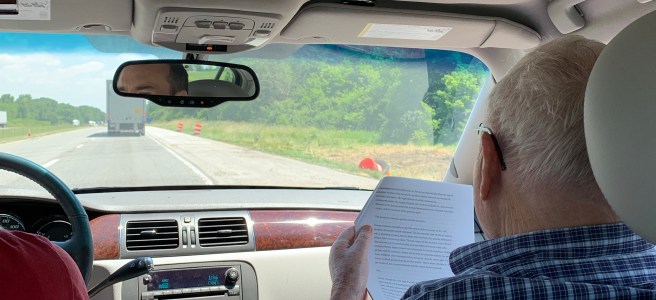
My brother is driving. I'm in the backseat at liberty to write. Dad, riding shotgun, shuffles through sheets of paper explaining stock valuations and physical therapy exercises.

The car is a 2015 Buick Lucerne with 62,000 miles on it and counting. Destination: Ludlow, Massachusetts, where my dad grew up, where he's from, where he still has family: his cousins, his aunt (who turns 88 in two days), his sister (who he hasn't seen in 25 years), his niece (likewise).

We left Belleville, Illinois, at 8 a.m. this morning, yours truly behind the wheel. Football (a.k.a. soccer) streams on satellite radio, channel 157, the European Championship tournament. This is the first round of the tournament, dubbed group play. Earlier, Russia knocked off Finland. Now, it's Turkey and Wales.

It's been awhile since I've been in a car's backseat. I'm enjoying it; it feels like a luxury. Like I'm flying on an airplane. What else is there to do but to read, to write? To describe, to explain, to tell?

At the first rest stop, my dad pointed at some new socks he was wearing.

"What do you think of these?" he asked...


Click to continue with my account of traveling by car to Ludlow, MA with my dad and brother to visit family there...

Coal Clams Are the New Storm Here

As we sat down at Mrs. Wilkes Dining Room on our last full day in Savannah, the arrangement of food on the table drew attention.  The number of items itself was only part of the story: sweet potatoes, cheesy potatoes, fried chicken, cornbread, corn, rutabaga, cole slaw, cukes, black-eyed peas, lima beans, stuffing, barbecued pork, cabbage, green beans, jambalaya, white rice, baked beans.  All in porcelain bowls with serving spoons.  This was a family-style meal.  The way it works is that you stand in line outside the restaurant for a half an hour or so.  When one of the tables inside opens up, seven to nine of the people standing in line take a spot at the open table.  When you sit down, the food is hot and ready to go.  You grab a bowl next to you and start loading your plate.  If there’s something you want in a bowl across the table, you ask for it to be passed.  

Anne-Marie didn’t initially sit down.  She set her purse on her chair and went to wash her hands.  Brook had her hand sanitizer out.  I had mine out.  The woman seated to my right asked to use one of the bottles.  She and her husband had driven up from Miami, though they hail originally from Spain.  They had planned to be in Japan this week but canceled that trip because of the outbreak.  The other couple at our table was from Michigan, bringing the total at the table to eight.

I was conscious of the way I handled the bowls when passing or receiving them.  But I also felt resignation.  What’s done is done.  Let’s just enjoy lunch, I thought.  Reflecting back on the meal I’m wondering about the family-style concept in the age of corona.  That restaurant is an institution.  The original Mrs. Wilkes’s grand-daughter came to our table in greeting.  Yet, with the way the news is trending overseas, the word ‘inevitable’ comes to mind.  How do we stop going out to eat?  How many traditions are we willing to concede?  How many will we lose one way or another?  I mean, I’m putting pen to paper on this trip not just because I’m a writer but with a mind to meeting an assignment for a travel writing class I’m taking at Washington University in St. Louis.  My readers are my classmates.  But I don’t know, as I sit here in Savannah, ready to go home, if my class will even convene later this month.  Stanford has already gone online...


What follows is an essay I wrote one year ago as the coronavirus pandemic was taking hold. After multiple unsuccessful attempts to publish it elsewhere, I am happy to publish it here on my blog today. Click here for the full essay and thanks for reading...

I Don’t Know What It Is About A Field—Part Two

Left Tucumcari, New Mexico at 8:40. The woman at the Best Western when I checked out says, "You look like you could use more sleep." Oh, thanks! What a nice thing for you to say. Yeah, I could have used some more sleep. But other guests stirring early, doors clanging, and then someone freaking out when a cat jumped out of the hallway trash can meant it was time for me to get out of bed. That and needing to drive another eight hours today.

I'm on U.S. Highway 54 headed east. This highway takes me all the way to Wichita. Land is mostly flat. Ranch land. Cattle grazing. Mesas in the distance, to the west. Lots of Aermotors. I've realized that's a trademarked name for the old-style windmills.

Lots of empty buildings here. There were lots of them in Tucumcari, too. That town is hollowed out. Abandoned homes. I suppose Tucumcari had its day. Post World War II. Car culture. Route 66. Before passenger air travel proliferated...


The second and final part of the travelogue continues here...

I Don’t Know What It Is About A Field

In eastern Butler County the fields opened up, took on the wispy gold of uncut hay. Not long after that hills appeared. I could see the outcome of geological events, the hint of a rock facade where the road cut through. But the grass didn't mind the hills and it ran long and uncut up and down the slopes still. A valley appeared, a vantage, a vista. I thought of some of that scene from Dances With Wolves where they creep up to a crest and look down to see a herd of buffalo grazing in peace.

It would've been a good place to stop but I was going 75 and I was only an hour into the drive. It's a spot to think about, for another. A spot worth reaching over into the glove compartment and pulling out this notebook for, an emergency notebook, never been written in before, the two notebooks I did bring secure in my bag.

I'm east of Wichita, KS on U.S. Highway 54, where Butler County ends and Greenwood County begins. Hay, cow ponds, the cattle so dark against the golden light of the field, dark against the blue of the sky, against the shapely hills.

FDR had some sort of windbreak tree-planting program. A shelterbelt. I never gave much thought to windbreaks, to trees as a line against the wind. This tree I keep seeing, that is so prevalent, must have been one of the trees of choice for the shelterbelt planting. It's often got a lopsided crown and most of the time its trunk splits into two not far from the ground, a couple of feet, maybe less. This tree, whatever it is, is not at Farm. It's a Dust Bowl thing. Kansas, Oklahoma, the Texas panhandle, northeastern New Mexico.


Continue with Part One of this travelogue...

Encounter with an Iberian Woodrat

Like the jigsaw puzzle suddenly nearing completion the pile was virtually gone. I had used the tarp to drag the piled debris to a new bonfire-to-be in the pasture. After the pile down below went up so easily yesterday afternoon I figured we could easily get this pile ablaze before dark.

The locust limbs split and hauled away, the thorny vines extirpated and lofted onto the pile, the only element of debris remaining where the brush pile once sat was a collection of tree detritus: twigs, leaves, the maroon pods of the honey locust. It was a curious collection, somewhat familiar-looking. I was grabbing at this melange with gloved hands and tossing some of it on the tarp to be hauled away. Doing this I stepped into a depression, wide but shallow. I started to get an inkling that I was disturbing a nest...


The full account is available here...

Pages from An Old Woodshed

I've been clearing out part of the shed. One of the bays. I think of it as a future café, or perhaps even a place to sleep. I'll show ya. I'm taking certain old items—tire, rim, an old heavy plow, pure iron, the weight—and moving them into a different shed. A junk shed.

Now I'm taking my drill out there to reinforce the structure a bit. This is my playground, my school, my office, my church.


To read much more, including a new theory of the universe, continue here...

Trip to See My Siblings, Sept-Oct 2019

Game via radio, Chicago feed. Pat Hughes, Ron Coomer, Zach Zaidman. The Cubs take the lead on an Ian Happ double. The regular season is almost over. Can you believe it? Like a wink. Wild pitch, Cubs add a run, it's 3-1.

We say it every year, and not just about baseball, but: where did the season go? Where did the time go? The months like water, like sand, like air. A temperature that will change and what can you do about it? No, nada.

As we drove north-northeast from Springfield today the skies were mixed. To the west, dark skies. Confused, malformed clouds. A blue darkness. We were along the flatness of Illinois. The sky extended as far as we could see in any direction...


North, to Chicago, go on...

Notas de Maleta de Tijuana 2.0

What follows is a thorough, categorical examination of what I took with me to Tijuana when I traveled there on a mission trip with members of the Burlingame Presbyterian church this past July. I wrote this mostly for my own benefit, in order to pack smarter next time I travel, to Tijuana or to anywhere. Writing this out, which I did on the first full day I was back at home, also serves as a sort of trip debriefing. It's a different way for me to record an account of the trip, albeit in a more straightforward and less lyrical style than what I wrote while I was actually in Mexico (which can be found here)...


Click here for the rest of the pack notes...

Tijuana Exodus & Old Tricks in San Diego

13:04. I'm in my room, 1415, at the Westin San Diego. This is two hours in the room I didn't think I'd have. Because check-in isn't until three o'clock. I'm grateful.

I've looked at myself in the mirror. I look rough! My cheeks are approaching brick red, or burgundy. I stink!

First order of business is a full-on shower. Then some walkin' around, looking perhaps for a notebook store. Then I'm going to that burrito place I went to a year ago. I'm-a get two burritos, one for this afternoon, one for dinner...


Continue with this short travel essay...

Tijuana Mission Trip 2.0

We're between mountains, like in Colorado, or Utah. Wall! Border wall. To our left, to the north. Contiguous. Iron? A rusty red. Eight feet high? It cuts into the hillside.

Suddenly it's a little greener. Wind in the palms. Some flattening out. By the looks of it, the playa at camp will be windy. Stones, boulders on the hillsides. I've lost sight of the wall as we've tended south.

This is a smooth road. Turning to the south. Large round boulders. Accesso planta dart. Windmill. This is the back way into camp. It has a rural feel but there's actually quite a few plants or factories back in here. The road has gotten very rocky. A metal structure manufacturer. Galvanization. A burned area. Car carcasse. Lots of old tires. A guy in a chair under the shade of a tree just looking out at the road. Railroad.

We take a right onto a much smoother, paved road. There are lots of cars stopped on the side of this road. There are canopies set up. Lots of them. Is it a market? We're close to camp. Turning right, I know this road. There's the old, snub-nosed flatbed lorry. The silo-like red cylinder lying on its side. Dust! At 14:42 we are at the Amor Hacienda Camp...


Continue with this Tijuana 2019 travelogue...